A few weeks ago I visited a mattress factory in Argentina. The owner proudly showed me his new production line — quilting machine, sewing machine, tape edge, all running well. But when we walked around the back, I saw something that caught my attention: a huge pile of foam scraps stacked against the wall. I asked him how much he throws away per week. "I don't know, maybe 200 kilos." I asked if he knew what that cost him per year. Silence.
We did a quick calculation. 200 kilos of foam per week is over 10,000 kilos per year. Depending on density, the raw material value is about $3,000-5,000. But he wasn't just losing the material — he was paying to have it hauled away. The waste container cost him $200 per week.
Most mattress manufacturers don't think of foam waste as something that could generate income. They see it as an unavoidable production cost. But foam scraps can be shredded into granules and reused to make rebond foam — which has its own market and its own buyers. What's costing you money to dispose of could be creating a new revenue stream. Or at minimum, eliminating your disposal cost.
Most mattress factories generate 5-15% foam waste depending on cut complexity and process efficiency. For every 1,000 kg of foam entering your factory, 50-150 kg ends up on the cutting room floor or in the dumpster.
At a factory producing 200 mattresses per day, that's easily 10,000-15,000 kg of foam waste per year. At current virgin foam prices, that represents $5,000-10,000 in lost material annually. And if you're also paying for waste disposal, the real cost is even higher.
What most manufacturers don't know: that foam waste isn't trash. It's raw material for another manufacturing process. Shredded foam mixed with adhesive becomes rebond foam — used in carpet underlay, budget mattresses, packaging, and insulation. There's an active market for this material, both for internal use and for sale to other manufacturers.
The rebond foam manufacturing process is straightforward but requires the right equipment to do it properly. First, foam waste is cleaned of impurities like fabric, thread, or adhesives. Then the IF-FFS3 shreds it into granules of the desired size — typically between 5 and 30 mm, depending on the end use. Smaller granules produce denser, firmer foam; larger granules give softer, more flexible foam.
Once shredded, the foam is mixed with a special adhesive (polyurethane or latex) in the IF-FZS1/2. The adhesive ratio determines the final firmness of the block. The mixture is placed in a mold and compressed using the machine's hydraulic system. After pressing, the block needs to cure for 12-24 hours before it's ready to cut and use.
The result is a rebond foam block that can be sliced into sheets and used for a variety of applications: budget mattress bases, technical carpet underlay, industrial packaging, acoustic insulation, and more. It's a material with consistent demand and attractive margins.
Infinity Mattress Machinery offers two machines that work together to turn foam scraps into a sellable product. The first is the IF-FFS3 Crushing Foam Machine, a crusher with imported cutters that reduces scraps into small, uniform granules. It has 4 fixed cutting lines and 3 rotary cutting lines — purpose-built for foam, not a adapted industrial shredder.
The second machine is the IF-FZS1/2 Re-Bonding Foam Machine. Once the IF-FFS3 has shredded the foam, the FZS1/2 mixes the granules with adhesive, pours them into a mold, and presses them with a hydraulic system to produce rebond foam blocks at the desired density.
The Argentine factory owner ended up buying both. The IF-FFS3 shreds his daily scraps and the IF-FZS1/2 turns that material into rebond foam blocks that he sells to a local carpet manufacturer. What used to cost him $200 per week in waste disposal now generates about $400 per week in revenue. Net difference: $600 per week in his favor. That's over $30,000 per year — the machines paid for themselves in 8 months.
1. Sell foam granules. Install the IF-FFS3 only, shred your scraps, and sell the granules to rebond foam manufacturers. Lowest investment, fastest to implement.
2. Produce and sell rebond blocks. With both IF-FFS3 and IF-FZS1/2, produce finished blocks and sell directly. Higher margin but more investment.
3. Use rebond foam in your own products. Replace virgin foam with recycled foam in budget mattress lines, bases, or packaging. Highest value-add — integrates recycling directly into your supply chain.
The direct economic benefit — turning a disposal cost into an income source — is reason enough to consider foam recycling. But manufacturers discover other benefits after implementing the system.
Environmental footprint reduction. More customers and governments demand sustainable manufacturing. Being able to demonstrate that you recycle foam waste is an increasingly important sales argument, especially in export markets. Some buyers already ask about the percentage of recycled material in mattresses. Having an internal recycling process gives you a story to tell.
Lower waste disposal costs. In many regions, industrial waste disposal costs are rising fast. Landfills charge more, regulations get stricter, and waste transport gets more expensive. Reducing the volume of waste you send to the landfill directly impacts your operating costs.
New revenue stream. Rebond foam has applications across multiple industries: technical carpet underlay, budget mattresses, industrial packaging, acoustic insulation, furniture, and more. Once you start producing, you'll likely discover applications you hadn't considered.
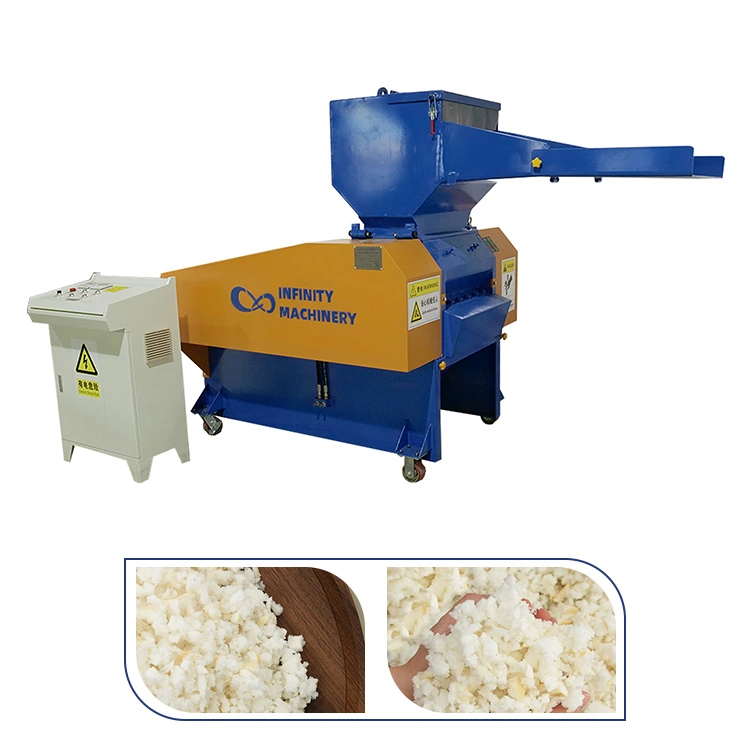
Foam crushing machine. 4 fixed + 3 rotary cut lines. Built specifically for foam scrap.
View IF-FFS3
Re-bonding foam machine. Mixes granules with adhesive, hydraulic press. Produces high-quality rebond blocks.
View IF-FZS1/2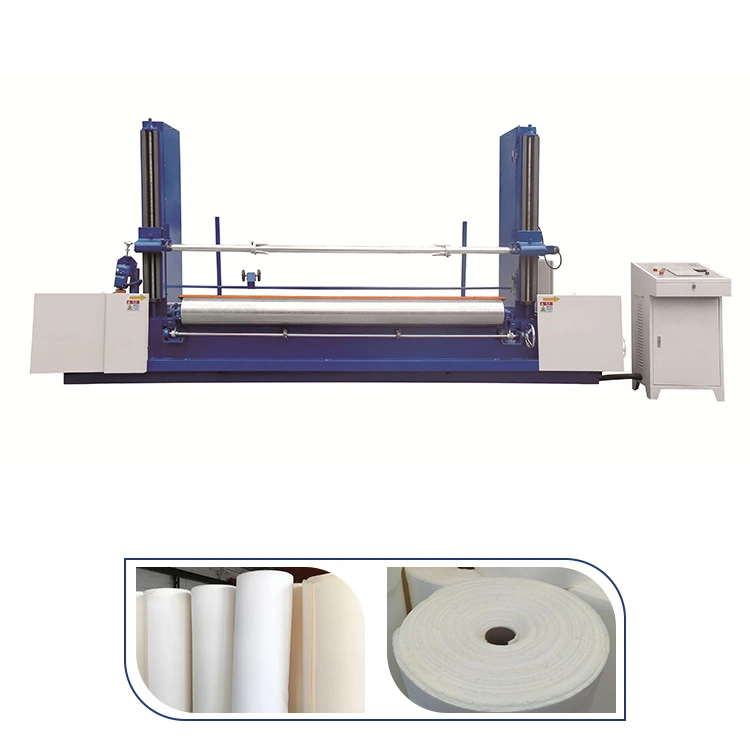
Foam peeling machine. Converts irregular blocks into uniform sheets. Complements your recycling line.
View IF-FYQ1Foam scraps aren't trash. They're raw material for a second production cycle that can eliminate a cost center and create a new revenue stream. The IF-FFS3 and IF-FZS1/2 from Infinity Mattress Machinery turn foam waste into a sellable product with an investment that typically pays back in under a year.
Figure out how much foam waste your factory generates. If the number surprises you, the next step is a conversation with Infinity's team to turn that number into an opportunity.
Tell us how many kilos of scraps you generate per week. We'll calculate your ROI on a crusher and rebond press — no obligation.

