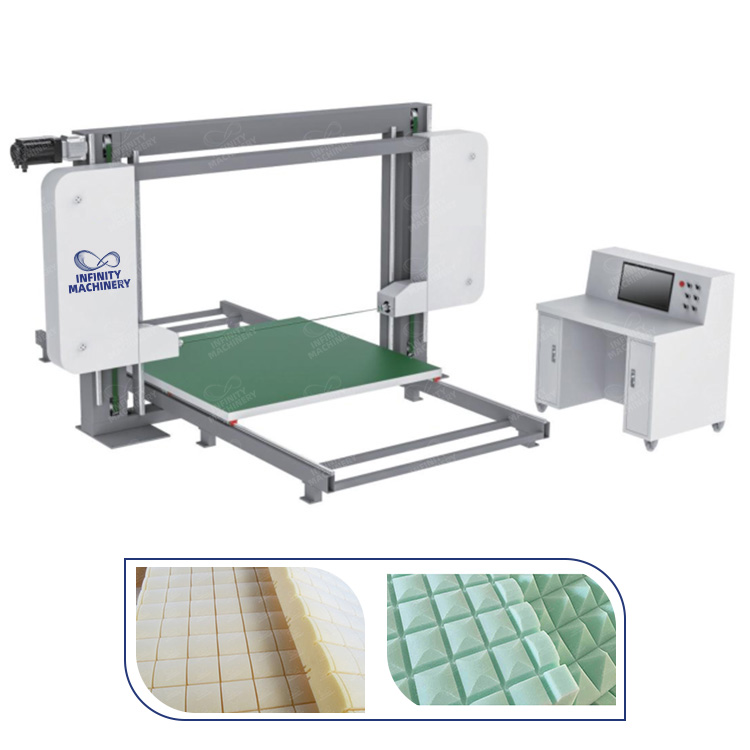
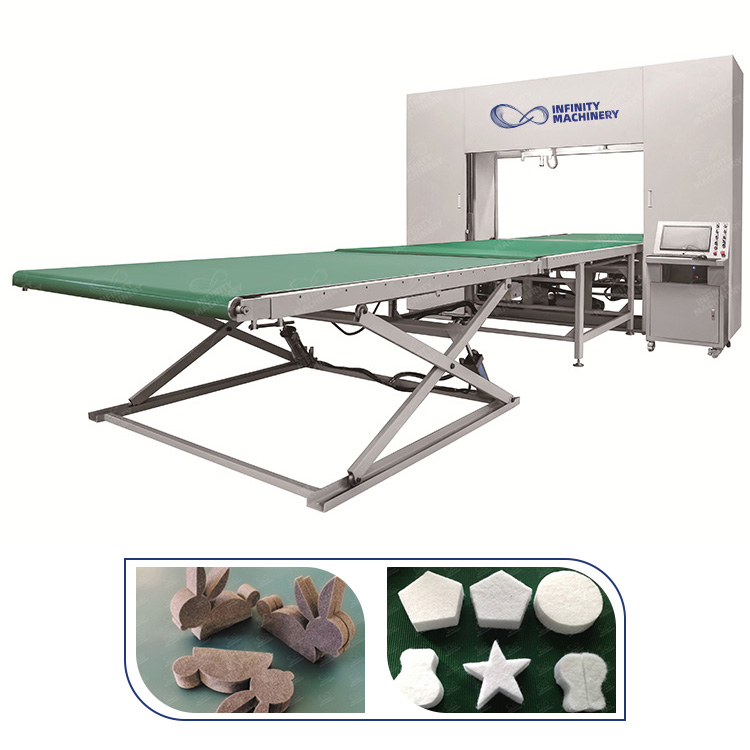
The following machinery units form the primary capacity generators within this end-to-end production line.
Foam cutting accuracy determines downstream mattress quilting, edge bonding, and assembly quality. Manual cutting introduces dimensional drift that compounds across stacked slabs, wasting material and generating inconsistent mattress cores. Servo-controlled horizontal and vertical cutting machines hold tolerance to +-1mm, enabling factories to nest multiple mattress profiles from a single slab with minimal kerf loss.
Accuracy Benchmark: Manual Tolerance +-5mm; CNC Cutting +-1mm; Kerf Loss <3%; Material Yield Increase up to 12%; Reduced Rework per Layer.
The IF-CNCH horizontal foam cutting machine uses a precision hot-wire or band system to slice full foam buns into thin sheets along the horizontal plane. Its large-format table accepts complete production blocks, while servo feed handles the material at a controlled rate for a consistent sheet thickness across the full cut width. This machine is the workhorse for converting raw bun stock into useable mattress layers.
Specifications: Horizontal Slab Cutting; Full-Bun Table; Servo Controlled Feed; Consistent Sheet Thickness; Large-Format Capacity.
The IF-CNCV vertical cutting machine processes foam in the vertical plane, splitting blocks and producing profiled shapes beyond what horizontal cuts achieve alone. Servo-driven tooling cuts, scoops, and contours foam for shaped mattress layers and toppers. Combined with the horizontal machine, the vertical unit enables complete in-house transformation of raw foam stock.
Specifications: Vertical Profiling; Contour & Shape Cutting; Servo Tooling Drive; Block Splitting; Complete In-House Foam Processing.
A horizontal-plus-vertical cutting configuration carries a CAPEX typically between $42,000 and $74,000. By cutting foam in-house instead of outsourcing to a sawmill, factories save $0.08 to $0.15 per mattress in toll-cutting fees while recovering material loss. Most producers reach breakeven within 6 to 9 months, accelerating payback as output scales with demand.
ROI Projection: Cutting CAPEX $42k-$74k; Toll-Cut Saving $0.08-$0.15/Mattress; Material Recovery +12%; Break-Even 6-9 Months; Scalable With Output.
The IF-QC-1 computerized panel cutter automates mattress quilt and outer-cloth cutting. Automated nesting arranges multiple panel pieces across the fabric roll to minimize waste, while precision cutting holds every piece to spec. Because panel fabric is a major input cost, nesting software typically reduces fabric waste from 7% to below 3%.
Specifications: Automated Nesting; Fabric Waste Below 3%; Precision Panel Cutting; Multi-Piece Layout; Fabric Cost Saving 4%+.
Cutting foam generates fine particulate that must be controlled to protect machinery and operators. Integrated extraction hoods collect dust at the cut line, keeping cutting tables clean and extending tooling life. Automated material handling transports slabs and panels between cutting, quilting, and assembly stations, reducing manual lifting and improving throughput.
System Design: Cut-Line Extraction Hoods; Clean Table Operation; Automated Material Transport; Tooling Life Extension; Reduced Manual Lifting.
A full cutting department requires dedicated 380V 3-phase power and clean compressed air. Layout space of 150 to 220m2 accommodates horizontally split cutting, vertical profiling, panel cutting, and staging zones. Extraction and compressed-air systems integrate into the plant utility backbone with balanced electrical load.
MEP Parameters: Power 24-42kW 3-Phase; Air Supply 0.6MPa; Footprint 150-220m2; Extraction Ducted; Load Balanced Across Zones.
Inline measuring verifies sheet and panel dimensions against recipe specifications, flagging deviations before they enter quilting. Statistical process control tracks material yield and kerf loss per production run so managers can tune cutting parameters. Finished foam layers are sampled for thickness consistency across the full surface.
Quality Gates: Inline Dimension Verification; SPC Yield Tracking; Kerf Loss Monitoring; Thickness Consistency Sampling; Full-Surface Check.
Precision-cut foam feeds directly into quilting machines and edge-bonding stations, producing uniform mattress assemblies. Because cutting is the first quality gate, accurate foam layers reduce downstream rework in the quilting department. This integration improves overall production flow and reduce rejects at the finished-mattress stage.
Process Flow: Block Cutting -> Panel Cutting -> Quilting -> Edge Bonding -> Assembly; Rework Reduction; Downstream Quality Improvement.
Infinity Mattress supplies factory-commissioned cutting lines with 8 to 12 days on-site installation and full operator training. Engineers calibrate servo tooling, set recipes, and instruct crews on maintenance. Remote diagnostics and a complete spare-parts kit support operations long after handover.
Deployment: Install 8-12 Days; Factory Commissioning; Operator Training; Remote Diagnostics; Complete Spares Kit.
A rolling pro-forma models cutting-department ramp from commissioning to two-shift operation. Early months establish accuracy and yield baselines; steady-state months deliver consistent slab consumption and material yield. Conservative utilization modeling confirms rapid capital return.
12-Month Summary: Monthly Slab Throughput 600+; Fabric Waste Saving 4%; Toll-Cut Saving $3,800/month; Break-Even Month 7; Utilization Floor 72%.
Answers covering cutting accuracy, cost, integration, and lifecycle operation.
Q1 Accuracy achievable? +-1mm on servo lines. Q2 In-house vs toll cutting? In-house saves $0.08-$0.15/mattress and recovers 12% material. Q3 Power? 24-42kW 3-phase. Q4 Space? 150-220m2 department. Q5 Warranty? 12-month parts and service.
A weekly view of cutting-department output and costs confirms the economics of in-house precision cutting.
Weekly Metrics: Slabs Cut 150; Panel Cuts 1,200; Toll-Cut Saving $950; Material Recovery $1,100; Extraction & Power $320; Net Margin $2,800.
Precision foam and panel cutting transforms raw material handling into accurate, repeatable production. Infinity Mattress delivers complete cutting departments with engineering, fabrication, installation, training, and life-cycle support.
Execution: Site Survey -> Cutting-Line Engineering -> Factory Fabrication -> Global Logistics -> Install & Training -> Production & Support.
Contact Infinity Mattress engineers for a custom production layout, installation guide, and full ROI projections.