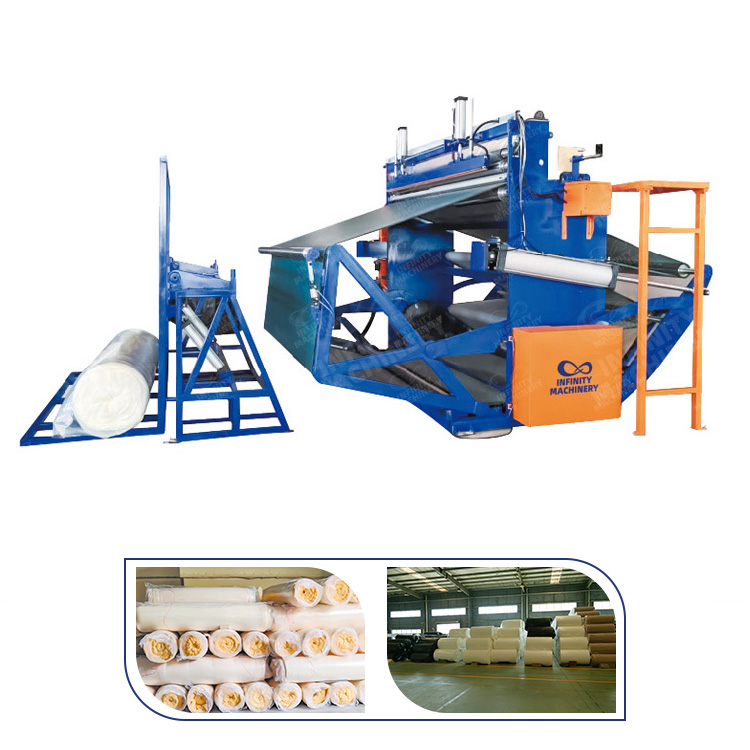
Raw foam is the most expensive thing a mattress factory stores. A continuous foam line produces blocks up to 2.3 meters wide and 50 meters long, and those blocks sit in the hall, in racks or on the floor, until the cutting department needs them. Uncompressed foam also travels badly: a truckload of loose foam blocks carries mostly air, freight is charged by volume, and every stored block competes for floor space with the packing and sewing lines. The IF-FCR3 Roll Foam Compressing Machine solves the storage and freight problem at the source: it takes rolled foam of 700 to 1,500 millimeters diameter and compresses it to 350 to 750 millimeters in a fully automatic cycle at 30 to 40 rolls per hour, with automatic loading and unloading. Paired with the IF-FS Foam Block Storage System and the IF-FC Foam Clamp, a foam logistics cell can cut warehouse space by up to 60 percent and freight volume by half, with the equipment typically paying back in nine months.
The warehouse is where foam factories lose margin before production even starts. Foam is sold by volume and stored by volume, and a mattress factory that buys 2.3-meter-wide blocks in 50-meter lengths needs a storage strategy, not just a storage area. Loose stacking wastes the vertical dimension, racks are expensive to build, and every square meter of storage is a square meter that the cutting, quilting, or packing line cannot use. The IF-FCR3 Roll Foam Compressing Machine attacks the problem on two fronts: it compresses rolled foam to under half its original diameter, which roughly quarters the volume of the roll, and it does so automatically, so the labor cost of handling stays near zero.
The freight math makes the case by itself. An uncompressed foam roll of 1,200 millimeters diameter occupies a cube of roughly 4.5 cubic meters per meter of length in the container; compressed to 600 millimeters, the same roll fits in under a fifth of the volume. A factory shipping foam products or half-finished rolls to a second plant typically cuts freight volume by 50 to 70 percent, and on international routes where freight is charged per cubic meter, that saving is often larger than the machine payment. Domestic factories capture the same benefit in reverse: compressed rolls from the supplier arrive at the door at half the volume, so the same truck brings more foam per trip.
The labor side is simpler but just as real. Handling long foam blocks is a two-to-four-person job: someone steadies the block, someone drives the forklift, and someone keeps the roll from skewing on the clamp. The IF-FC Foam Clamp carries blocks of up to 50 meters long and 2.3 meters wide with a 5.5-kilowatt drive, and its clamp length is customized to the factory block range, so one operator on a forklift moves what used to take a crew. The IF-FCR3 then takes over at the compress station: the operator positions the roll, and the automatic loading and unloading device handles the rest.
The strategic argument closes the case. Compressed storage changes the factory layout permanently: the same hall that held 400 loose rolls holds 800 compressed ones, and the reclaimed space can host a second cutting table or a tape-edge line without a building extension. Factories that treat foam compression as a logistics investment rather than a packaging accessory report that the machine pays back in nine months through freight, labor, and space savings combined, and that the payback repeats with every batch of foam that passes through the cell.
A foam logistics cell runs in four steps that can be installed next to an existing cutting department without stopping production. First, the IF-FC clamps the long foam block at the production line or delivery dock, carrying blocks up to 50 meters in length on a custom clamp with a total power of 5.5 kilowatts. Second, the block is either stored directly on the IF-FS system or cut into slabs and rolls. Third, the rolls move to the IF-FCR3 compress station, where the automatic loading device positions each roll for compression. Fourth, the compressed roll exits at 350 to 750 millimeters diameter and is palletized for storage or shipping.
The IF-FS Foam Block Storage System is the bridge between production and storage. It uses movable conveyor lines and lifting systems that transport foam blocks to designated storage locations automatically, coordinating the conveyors and lifts so blocks move without manual pushing or dragging. The operator issues simple instructions or parameter settings, and the system executes the entire transport, positioning, and retrieval sequence, which improves both convenience and efficiency in warehousing operations. The design is customized according to the sponge length and the storage quantity, so the system scales with the factory.
The IF-FCR3 compress cycle is fully automatic. The machine accepts compressed widths of 1,000 to 2,300 millimeters, takes rolls of 700 to 1,500 millimeters diameter, and delivers them compressed to 350 to 750 millimeters at an adjustable capacity of 30 to 40 pieces per hour. Total power is 8 kilowatts, and the machine envelope of L10000 by W3600 by H4800 millimeters fits into a standard hall bay. Because the cycle is automatic, one operator can run the compress cell and the clamp in sequence, which keeps the labor footprint of the whole foam logistics department at one person.
The foam logistics cell installs in a standard hall bay with three-phase power and does not require special foundations, because the clamp, storage conveyors, and compress machine all operate on level concrete. The table below summarizes the key technical data of the three units.
Installation takes about two weeks in an operating factory. The IF-FCR3 needs a bay of roughly 40 square meters including the compress station, a roll feed lane, and a pallet output area, with three-phase power for the 8-kilowatt draw. The IF-FS conveyor and lift layout is designed around the existing block length and storage quantity, and the IF-FC clamp is manufactured with the clamp length matching the factory block range. Infinity engineers commission all three units together, train the operators, and integrate the transport parameters with the cutting department schedule before handover.
A complete foam logistics cell deploys one IF-FCR3, one IF-FC clamp, and an IF-FS storage system sized to the block range. The equipment CAPEX, including installation, commissioning, and operator training, typically lands in the range of $28,000 to $38,000 depending on storage system scope and regional freight. The projection below models a mid-size mattress factory storing and shipping 3,000 cubic meters of foam per month.
IF-FCR3 Roll Foam Compressing Machine: accepts rolled foam of 700-1,500 mm diameter and delivers it compressed to 350-750 mm at an adjustable capacity of 30-40 pieces per hour, compressing widths of 1,000-2,300 mm, fully automatic control with automatic loading and unloading device, total power of 8 kW, machine dimensions of L10000 x W3600 x H4800 mm, compatible with the IF-FS foam block storage system and the IF-FC foam clamp in one logistics cell, CE-compliant electrical components, installation in a standard hall bay of roughly 40 square meters with three-phase supply.
The projection is conservative by design. It assumes a single shift, no renegotiation of freight contracts, and no credit for the sales benefit of delivering compressed, better-protected foam. Factories that run the compress cell on two shifts or use it to service both inbound supplier foam and outbound product rolls typically report payback inside six months, and the cell continues to run with a one-person crew instead of a handling team.
The foam logistics cell should sit between the delivery dock or foam line and the cutting department, because every foam block passes through it in one direction. The recommended configuration below balances dock flow, storage density, and cutting feed.
Layout discipline matters because foam flows by volume: the biggest blocks must travel the shortest distance, and the compressed rolls must leave without crossing the inbound lane. The IF-FS system removes the manual handling decision from the layout entirely, because the conveyors and lifts choose the storage location and the retrieval route from the operator parameters. With compressed storage, the same hall footprint holds roughly double the foam volume, so the buffer between delivery and cutting can grow without a building extension.
The logistics cell is engineered for continuous duty, with the compress machine built around automatic loading and unloading so the wear points are few and inspectable. Recurring consumables are PE film, sealing and strap materials, and clamp pad liners, restocked monthly and costing roughly $400 per month at full utilization. Structural maintenance is limited to quarterly lubrication of the conveyor and lift drives, annual hydraulic inspection of the compress station, and clamp pad replacement as needed.
Total annual operating cost for the cell typically stays under $14,000 including power, film, and consumables, which is less than three months of the freight and labor savings the cell produces. Compared with loose-foam storage whose cost grows with every additional rack bay, the compressed cell has a flat cost curve and a fixed footprint, which is why foam compression is the first logistics investment that profitable mattress factories make before extending the warehouse.
Raw foam is the highest-volume material in a mattress factory, and it is the one that most plants store by default instead of by design. The IF-FCR3 compresses rolls to under half their diameter at 30 to 40 per hour with one operator, the IF-FS stores and retrieves blocks automatically, and the IF-FC moves blocks up to 50 meters without a handling crew, cutting warehouse space by up to 60 percent and freight volume by half.
The decision rule is simple: if the factory stores loose foam blocks on the floor, if foam freight is charged by volume, or if the warehouse has become the constraint that blocks the next cutting table, the foam logistics cell is the highest-return investment available in the storage department, with a sub-nine-month payback and no compromise on foam condition. Install the clamp, the storage system, and the compress cell, measure the freight and space numbers for one quarter, and let the savings justify the second cell before the next foam order lands at the dock.
Contact our machinery engineers today for a custom foam logistics cell layout, storage system design for your block range, compress station integration, and a factory-direct quotation for your mattress plant.