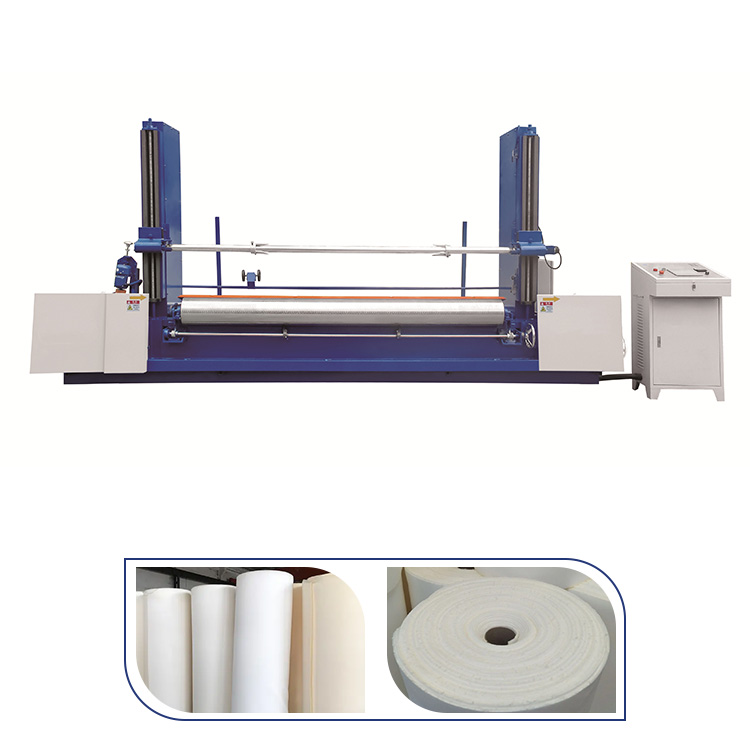
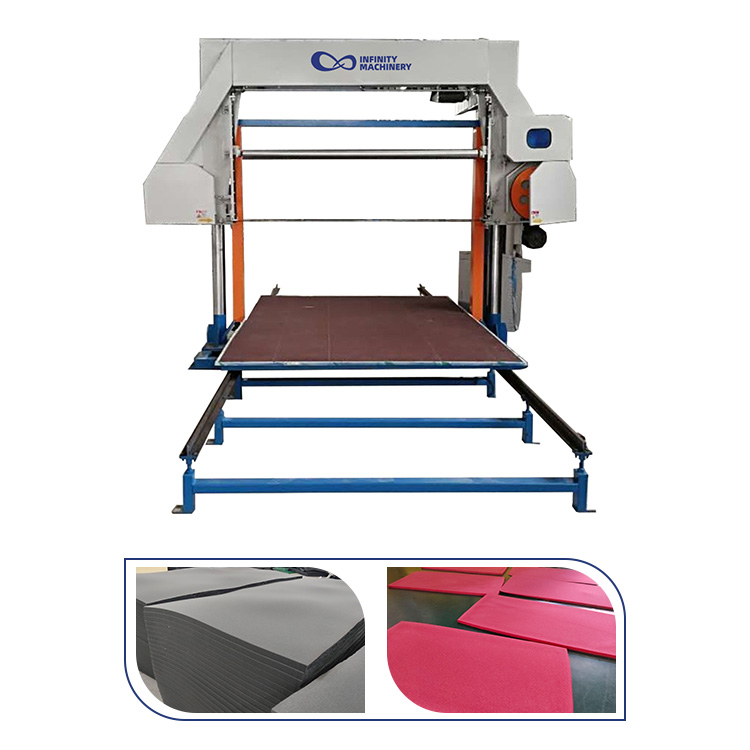
Thin foam sheet is the highest-margin product a foam factory makes, and it is the one that manual slicing cannot produce at scale. Mattress factories use thin sheets for topper layers, quilting foam, and comfort lamination, while furniture and packaging plants use them by the kilometer; but cutting a 2,000-millimeter roll of foam into continuous 3-millimeter sheets by hand is impossible, and horizontal sawing stops at around 20 millimeters without significant waste. The IF-FYQ1 Foam Peeling Machine solves the problem the way a lathe solves round stock: it rotates the cylindrical foam block against a long blade and peels continuous sheets of 1 to 30 millimeters thickness, rolling each sheet automatically as it is cut, with precision settable down to 0.1 millimeters. Paired with the IF-FPQ1-1650/2150 Horizontal Foam Cutting Machine and the IF-FZQA Automatic Vertical Foam Cutting Machine, a sheet line turns a standard foam block into saleable sheet stock in one pass, and the margin on sheet versus block typically pays back the line in seven months.
Foam sheet is where volume meets margin. A standard polyurethane block of 2,150 by 1,200 millimeters sells by the cubic meter, but the same foam, peeled into 3 to 10 millimeter sheets and sold by the square meter, carries two to three times the margin, because the converting labor is the product. The IF-FYQ1 Foam Peeling Machine is the converting machine: it accepts a cylindrical foam roll of up to 2,000 millimeters diameter and 2,150 millimeters width, and peels continuous sheets of 1 to 30 millimeters at a turning speed of up to 30 meters per minute, rolling each sheet automatically as it is cut. The blade runs 8,940 millimeters long, and the thickness can be set by PLC with a precision down to 0.1 millimeters instead of by gear adjustment.
The margin math is straightforward. A mattress factory that buys 10-millimeter topper sheet from a converter pays the converter's margin on every square meter; a factory that peels its own sheet from block pays only the raw foam cost plus electricity and blade wear. At typical regional prices, converting cost per square meter of thin sheet is a third to a half of the purchased price, which on a plant using 5,000 square meters of sheet per month is a monthly saving of $1,500 to $2,500. The same logic applies to packaging foam, protective layers, and furniture cushion sheet, all of which the same machine can produce.
The technical advantage of peeling over sawing is precision and yield. A horizontal band saw cutting a 5-millimeter sheet loses the saw kerf and struggles below 20 millimeters, while peeling produces a continuous sheet with no kerf loss at all and holds 0.1-millimeter tolerance, which matters for lamination and quilting where thickness variation shows up as unevenness in the finished product. Because the IF-FYQ1 rolls the sheet automatically, the output is ready for storage or lamination directly, without a separate winding step, and one operator can run the whole sheet line.
The strategic case is about product range. A factory with a peeling machine can offer mattress topper layers, pillow fill, packaging protection, and furniture sheet from the same block, which lets it quote complete products instead of raw material. The sheet line also consumes the offcut and round-core foam that a cutting department would otherwise sell at scrap value, turning the waste stream into a second revenue line. For a mid-size mattress factory, that combination typically pays back the sheet line in seven months.
A complete sheet line processes a foam block through three stations. First, the IF-FZQA Automatic Vertical Foam Cutting Machine splits the block into slabs of the required sheet width, cutting foam up to 1,200 millimeters high with a 2-millimeter minimum thickness at a moving speed of up to 30 meters per minute; the digital control sets the thickness and blade height from the control box, and the pressing system holds the foam steady during the cut. Second, the slabs are shaped into round rolls for peeling, or the cylindrical foam blocks go directly to the IF-FYQ1. Third, the IF-FYQ1 peels the roll into continuous sheets of 1 to 30 millimeters and winds each sheet automatically.
The IF-FZQA worktable accepts blocks of L2440 by W1700 millimeters with cutting height up to 1,200 millimeters, and the baffle speed runs to 10 meters per minute for the return stroke. Its total power is 4.92 kilowatts, and the blade length of 9,720 millimeters covers the full block width in one pass. The digital control stores thickness and blade-height settings, so the operator switches between sheet products by entering numbers instead of re-tooling the machine.
The IF-FPQ1-1650/2150 Horizontal Foam Cutting Machine covers the thicker sheet range that peeling is not designed for. It cuts block foam into slices of 2 to 200 millimeters on a fully automatic digital worktable, in two sizes: the IF-FPQ1-1650 handles blocks of L2000 by W1650 by H1200 millimeters, and the IF-FPQ1-2150 handles L3000 by W2150 by H1200 millimeters. The table speed runs to 30 meters per minute, the blade length is 8,500 or 9,480 millimeters, total power is 8.32 kilowatts, and a vacuum option can be added to hold thin slices in place.
The three machines share one operating philosophy: digital thickness control, automatic table movement, and pressing systems that hold the foam during the cut. That means one operator can run the full line, switching between vertical slabs, thick horizontal slices, and thin peeled sheets according to the production schedule, with the same measurement discipline across all three stations.
The sheet line installs in a standard cutting hall with three-phase power, and the three machines line up in sequence with a small worktable between them for slab transfer. The table below summarizes the key technical data.
Installation takes about one week in an operating factory. The line needs a bay of roughly 60 square meters including the three machines, a block staging area, and a sheet storage rack, with three-phase power for the combined 18-kilowatt load. The IF-FYQ1 can be delivered with PLC thickness control, which the operator programs per product; the optional vacuum kit on the IF-FPQ1 is recommended for plants cutting sheets thinner than 10 millimeters. Infinity engineers commission all three machines, calibrate the thickness systems, and train the operators before handover.
A complete sheet line deploys one IF-FYQ1, one IF-FPQ1-1650/2150, and one IF-FZQA with the vacuum option. The equipment CAPEX, including installation, commissioning, and operator training, typically lands in the range of $18,000 to $26,000 depending on machine size and accessories. The projection below models a mattress factory converting 5,000 square meters of thin sheet per month from its own blocks.
IF-FYQ1 Foam Peeling Machine: accepts cylindrical foam of up to 2,000 mm diameter and 2,150 mm width, peels continuous sheets of 1-30 mm thickness with PLC-settable precision down to 0.1 mm, turning speed of 0-30 m/min, automatic sheet rolling, blade length of 8,940 mm, total power of 4.67 kW, machine dimensions of L4600 x W1700 x H2000 mm, compatible with the IF-FPQ1-1650/2150 horizontal cutter and the IF-FZQA vertical cutter in one sheet line, CE-compliant electrical components.
The projection is deliberately conservative. It assumes no credit for selling peeled sheet to outside customers, no value for the production flexibility of switching thickness by program, and no saving on the blocks that the factory would otherwise sell at scrap price. Factories that run the line on two shifts or sell sheet to local furniture and packaging plants typically report payback inside six months, and the line keeps converting blocks at a margin that purchased sheet can never match.
The sheet line should sit at the head of the cutting department, because block storage feeds it and the sheet output feeds lamination, quilting, and packaging. The recommended configuration below keeps the block flow, the machine sequence, and the sheet output in one direction.
Layout discipline matters because sheet products are ordered by thickness and density, not by block. The staging area should keep blocks grouped by formula so the operator pulls the right raw material for the day's product mix, and the sheet rack should be organized by product family so lamination and quilting pull rolls without searching. With the three-machine line in sequence, one operator moves the block forward through the stations and the whole conversion happens in one hall flow.
The sheet line is engineered for continuous converting duty, with the three machines sharing standard electrical components and digital controls. Recurring consumables are peeling and saw blades, guide rollers, and pressing pads, restocked monthly and costing roughly $280 per month at full utilization. Structural maintenance is limited to quarterly blade-tracking checks, annual bearing inspection on the turning station, and periodic vacuum-table filter cleaning.
Total annual operating cost for the line typically stays under $7,000 including power and consumables, which is less than two months of the converting margin the line produces. Compared with buying converted sheet, whose price includes the converter's margin, labor, and freight on every delivery, the in-house line has a flat cost curve and a margin that compounds with every square meter converted.
Thin foam sheet is the highest-margin product a foam factory can make from a standard block, and it is the one that manual slicing cannot produce. The IF-FYQ1 peels 1 to 30 millimeter sheets at 0.1 millimeter precision with automatic winding, the IF-FPQ1 covers the thick slice range, and the IF-FZQA splits blocks up to 1,200 millimeters high, turning one block into a full sheet product range with one operator.
The decision rule is simple: if the factory buys more than 2,000 square meters of sheet per month from converters, or if offcuts and round cores leave the hall at scrap value, the sheet line is the highest-return converting investment available in the cutting department, with a sub-seven-month payback and no compromise on thickness consistency. Install the line, measure the converting margin for one quarter, and let the savings justify the second peeling machine before the block inventory grows.
Contact our machinery engineers today for a custom sheet line layout, PLC thickness program setup for your sheet products, vacuum table configuration, and a factory-direct quotation for your foam processing plant.