If you're a mattress manufacturer who has been in business for more than a few years, you've probably noticed the shift happening in the market. Pocket spring mattresses are taking over the mid-to-high end. Bonnell springs still dominate the budget segment and certain export markets. Both technologies work. Both have their place. But the equipment you choose for each one is completely different — and the wrong choice can cost you hundreds of thousands of dollars in wasted capacity. Let me break down what I've seen work across different factories.
The honest answer is that your spring system should be driven by your target market, not by which machine seems cooler or more advanced.
Sell to North America, Europe, or premium hotels? You need pocket springs. That's what buyers in those markets expect. A Bonnell spring mattress in those markets is seen as budget-grade, and you'll compete mostly on price. Pocket springs command a 30-50% premium at retail.
Sell to Latin America, Africa, parts of Asia, or budget domestic markets? Bonnell springs still dominate. They're cheaper to produce, the equipment costs less, and customers in those markets are used to the feel. Trying to sell a pocket spring mattress at Bonnell prices destroys your margin.
Sell to both? That's where it gets interesting. Some factories run both systems side by side. It's more capital upfront but gives you flexibility to shift production based on demand. More on that later.
Pocket spring production is more capital-intensive upfront. You need a coiling machine that wraps each spring in fabric individually — the IF-P130-1 CNC Automatic Pocket Spring Coiling Machine is Infinity's workhorse for this. It's a fully CNC-controlled machine that stores spring dimension parameters, so you can switch between spring sizes in minutes rather than hours. It also has a compact footprint — important if factory space is tight.
After coiling, you need an assembly machine that glues or bonds the individual pocket springs into a mattress unit. The IF-PPA Fully Automatic Pocket Spring Assembly Machine does this at high speed with full CNC control. It uses mechanical transmission and requires very low air pressure — meaning you don't need a big compressor running all day, which saves on electricity.
For higher-volume operations, the IF-P180-2 is a dual-wire input machine that can produce multi-zone pocket springs — different firmness zones in the same mattress. It's fully mechanical drive, no air compressor needed, so it saves power. It pairs naturally with the IF-PPA for a complete pocket spring line.
Bonnell production is simpler and less capital-intensive — which is exactly why it still dominates in price-sensitive markets. The IF-B90 Bonnell Spring Coiling Machine produces individual Bonnell springs at 80 pieces per minute, with automated knotting and heat treatment built into the cycle. One machine, one operator, steady output.
From there, the springs go to an assembly machine. The IF-BA Automatic Bonnell Spring Assembling Machine links the individual springs into a connected unit — the traditional innerspring matrix that goes into a mattress. It's a straightforward mechanical process: high efficiency, simple operation, stable performance.
For factories that want to go from bare wire to finished spring units in one continuous process, the IF-BPL100 Bonnell Spring Units Production Line combines coiling and assembly into a single integrated line. It's the highest-throughput option for Bonnell production, producing innerspring units directly from the wire.
There's also a lower-cost entry point: the IF-PA Semi-Automatic Pocket Spring Assembler is a budget-friendly option for factories that want to start pocket spring production without the full investment. It's semi-automatic, meaning it has a lower purchase price but requires a bit more operator involvement. It's a common choice for factories doing 50-100 pocket spring mattresses per day who plan to scale up later.
A factory I worked with in Colombia runs both systems. They export pocket spring mattresses to the US and sell Bonnell mattresses domestically. Here's how they set it up:
Their production manager told me: "If we only did pocket springs, we'd have higher margins but we'd leave the local market wide open for competitors. If we only did Bonnell, we'd never break into exports. Running both is more work, but it's also more stable. When one market dips, the other picks up."
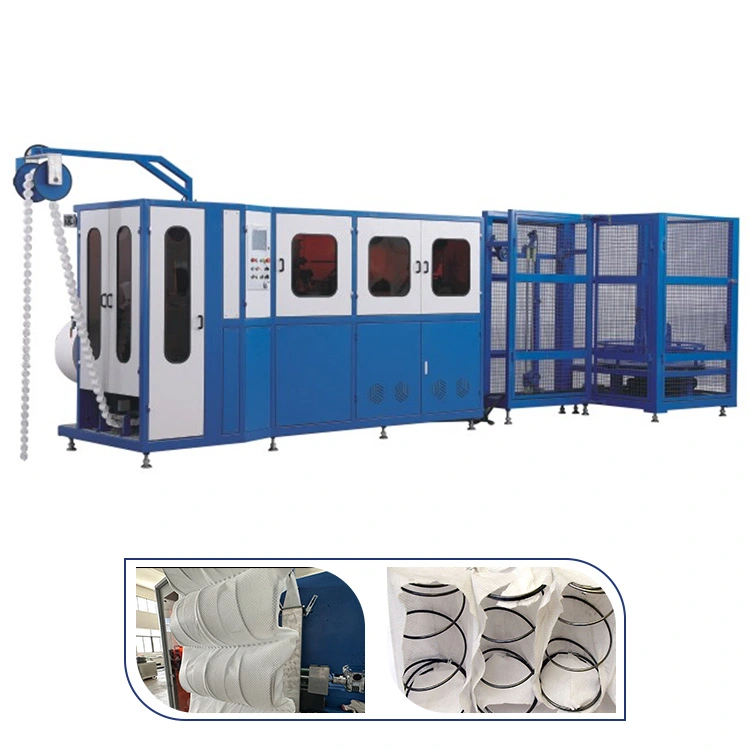
CNC automatic pocket spring coiling. Stores spring parameters, compact footprint, servo-driven.
View IF-P130-1
High-speed Bonnell spring coiling. 80 springs/min with automated knotting and heat treatment.
View IF-B90There's no objectively "better" spring system — there's only what fits your market. If your customers are in North America or Europe and demand pocket springs, put your money into a pocket spring line. If you're selling into markets where Bonnell is the standard, Bonnell equipment gives you a faster payback. If you can swing both, you get the best of both worlds and hedge against market shifts.
Infinity offers complete solutions for both systems — from individual coilers to fully integrated assembly lines. Their team can help you figure out which setup gives you the best ROI for your specific market mix. A quick call with their sales engineers can save you months of research.
Tell us where you're selling and your target volume. We'll recommend the setup that gives you the fastest return.

