A few months ago I was talking to a production manager at a mattress factory in Mexico. They were doing about 150 mattresses a day, mostly for the domestic market. He knew their foam cutting was inefficient — they were using an old vertical cutter that had been there since the factory opened. What he didn't know was exactly how much that old machine was costing them. So we spent a day measuring. The numbers were worse than he expected.
Here's what we found. Their old vertical cutter had a worn blade and the guide rails had enough play that each cut varied by 3-5mm. That doesn't sound like much, but when you're cutting 20 slices per mattress and each slice is off by a few millimeters, the waste adds up. They were losing about 20% of every foam block to uneven cuts and re-trimming.
On top of that, the machine could only handle blocks up to 1.8 meters wide. Their foam supplier delivered 2-meter blocks as standard. Every block, they had to manually trim 10cm off each side before cutting. That was another 5% waste — and 20 minutes of labor per block.
Then there was the downtime. The old machine broke down about once a month. Each breakdown took 4-6 hours to fix because parts were hard to find. That's 4-6 hours of the entire production line waiting on foam.
When I added it all up for him — foam waste, extra labor, and lost production from downtime — the old machine was costing them roughly $4,200 per month. Against that number, a new machine didn't look like an expense anymore. It looked like the solution to a $50,000-a-year problem.
He went with the IF-CNCH Horizontal Blade Foam Cutting Machine. It's called a "horizontal blade" cutter because the blade runs horizontally through the foam block lengthwise — cutting long blocks into precise slices. The machine is controlled by a PC system with X, Y, and C axis command settings. You can program the width of each slice, and the machine handles the rest.
The IF-CNCH has a servo drive system with high-precision guide rails. It uses a continuous blade, which means lower noise and more consistent cutting compared to the reciprocating blade on the old machine. The cutting tolerance is within 1mm, compared to the 3-5mm they were getting before.
It also handles blocks up to 2.2 meters wide — which meant they could stop trimming 10cm off every block. That alone saved them the 5% waste and the extra labor.
For factories that cut long continuous foam buns — the kind that come out of a continuous foaming plant — the IF-CNCH pairs naturally with the IF-LT1650 Long Track Cutting Machine. The LT1650 is purpose-built for long block foam: it uses a digital control system, the worktable runs automatically, and you set the thickness you need. Together they form a complete cutting station. But even on its own, the IF-CNCH was a massive upgrade over what they had.
Three months after installing the IF-CNCH, here's what the numbers looked like:
The production manager told me the machine paid for itself in 10 months. After that, every month of waste reduction and extra output was pure gain. His exact words: "I should have done this two years ago. I kept thinking we couldn't afford a new machine. What I didn't realize was how much we were paying for the old one."
That's the thing about old foam cutting equipment. It doesn't show you a bill. It just quietly wastes material, burns labor hours, and breaks down at the worst possible moment. The cost shows up everywhere except where you're looking for it.
Based on what I've seen across different factories, here are the red flags that your current cutting setup is bleeding money:

Horizontal blade CNC cutter. PC controlled, servo drive, high-precision rails. Cuts blocks up to 2.2m wide within 1mm tolerance.
View IF-CNCH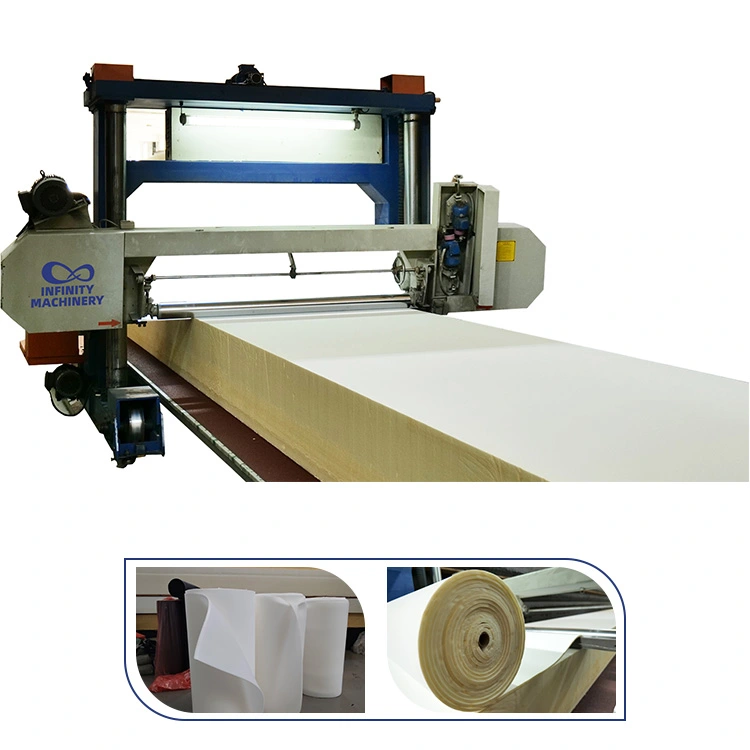
Long track horizontal cutter. Automatic digital control. Purpose-built for continuous foam buns and long block slicing.
View IF-LT1650The IF-CNCH is the machine that production manager chose, and it's the right choice for most factories doing general foam cutting — blocks of various sizes, precise slicing requirements, PC-controlled flexibility. It handles up to 2.2m block width, which covers the standard foam block sizes used by most mattress manufacturers.
The IF-LT1650 is more specialized. If you're running a continuous foaming line (like the IF-FF4) or you buy very long foam buns and need to break them down into slices efficiently, the long track design is purpose-built for that workflow. Its automatic digital control means you set the thickness once and let it run.
Both machines are CE certified, both use standard components that Infinity can ship from stock, and both will cut your foam waste dramatically compared to old or manual equipment. The payback period for either machine is typically under 12 months for a factory doing 100+ mattresses per day.
That production manager in Mexico? A year later, he's running 200 mattresses a day, exporting to Central America, and his foam waste is down to 2%. He told me the IF-CNCH was the best equipment decision he's made in five years. Not because the machine itself is amazing — though it's good — but because fixing the foam cutting bottleneck unlocked everything else.
You don't need to take my word for it. Here's a simple way to check if your foam cutting is costing you more than a new machine would: add up your foam waste percentage, the labor hours spent on trimming and re-cutting, and any production downtime caused by cutter breakdowns. Multiply by 12 months. If that number is more than half the price of a new IF-CNCH or IF-LT1650, you already have your answer.
Most factories I've worked with find that their hidden foam cutting costs add up to $30,000-$60,000 per year. Against that, a new machine is not an expense. It's a correction.
Tell us what you're cutting now and at what volume. We'll tell you what a new machine would save you — and how fast it would pay for itself.

